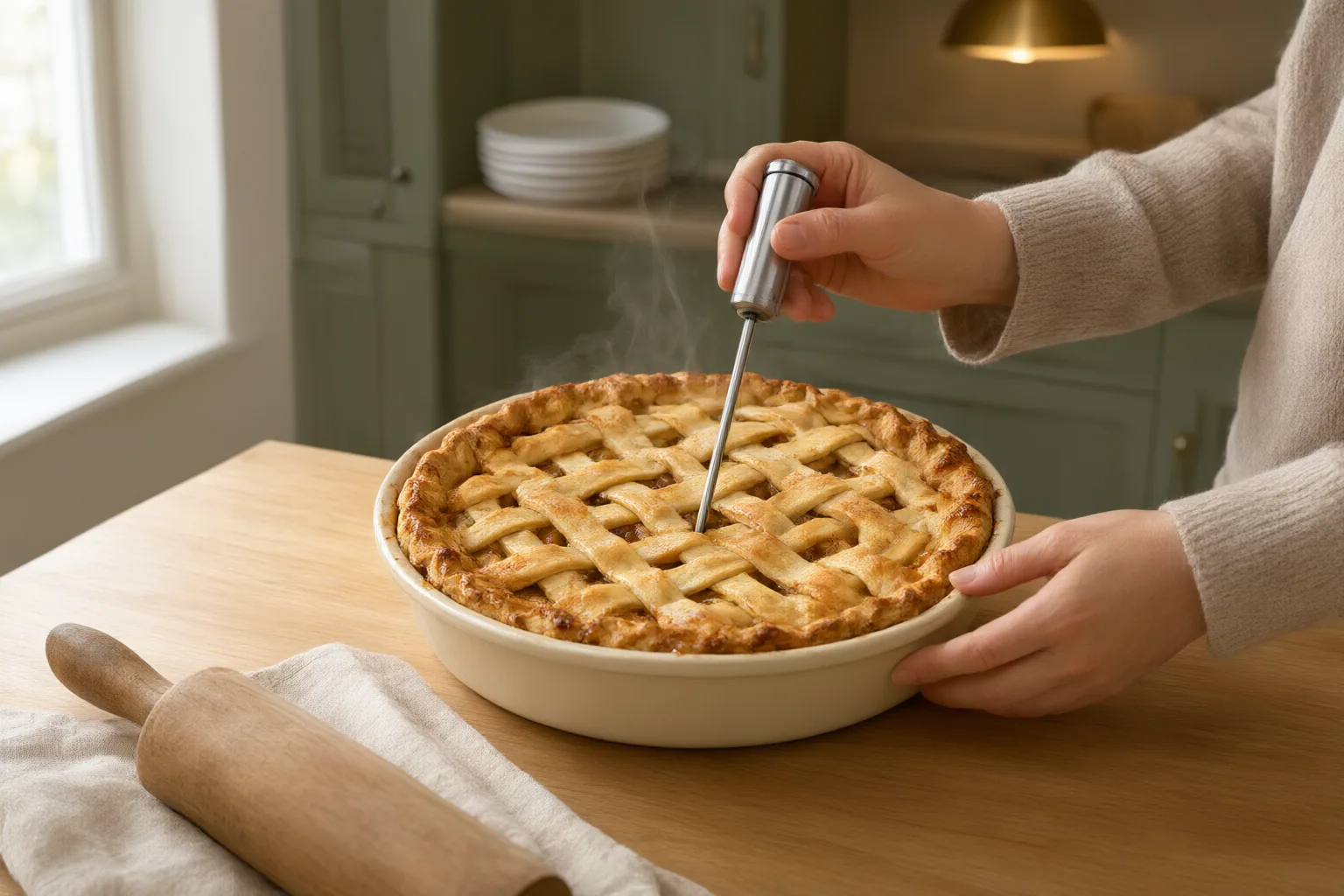
Follow the pie’s label, use equipment that reheats rather than merely holds food warm, and check the center with a food thermometer before serving. A hot or steaming surface does not prove that the middle is heated through.
Check the Center, Not Just the Surface
A refrigerated pie can be hot at the crust or surface while remaining cold in the middle. One cited food scientist therefore recommends inserting a food thermometer into the center instead of judging reheating by steam, appearance, or touch. ServSafe Practice similarly advises checking the center of reheated food with a probe.
Begin with the product label whenever one is available. Its directions can account for the particular pie, packaging, and intended preparation in ways that general leftover guidance cannot. Follow those directions without substituting an invented oven temperature or reheating time. When measuring, position the thermometer in the center of the food rather than relying on a surface reading. Check more than one central area if the pie’s shape or filling makes uneven heating plausible, while avoiding contact with the pan because that would not represent the food’s temperature.
The supplied sources do not establish one universal target for every refrigerated pie. The appropriate instructions can depend on the ingredients, handling history, and intended service, so label-specific guidance should control where provided.
Use a Method That Heats the Pie Promptly and Evenly
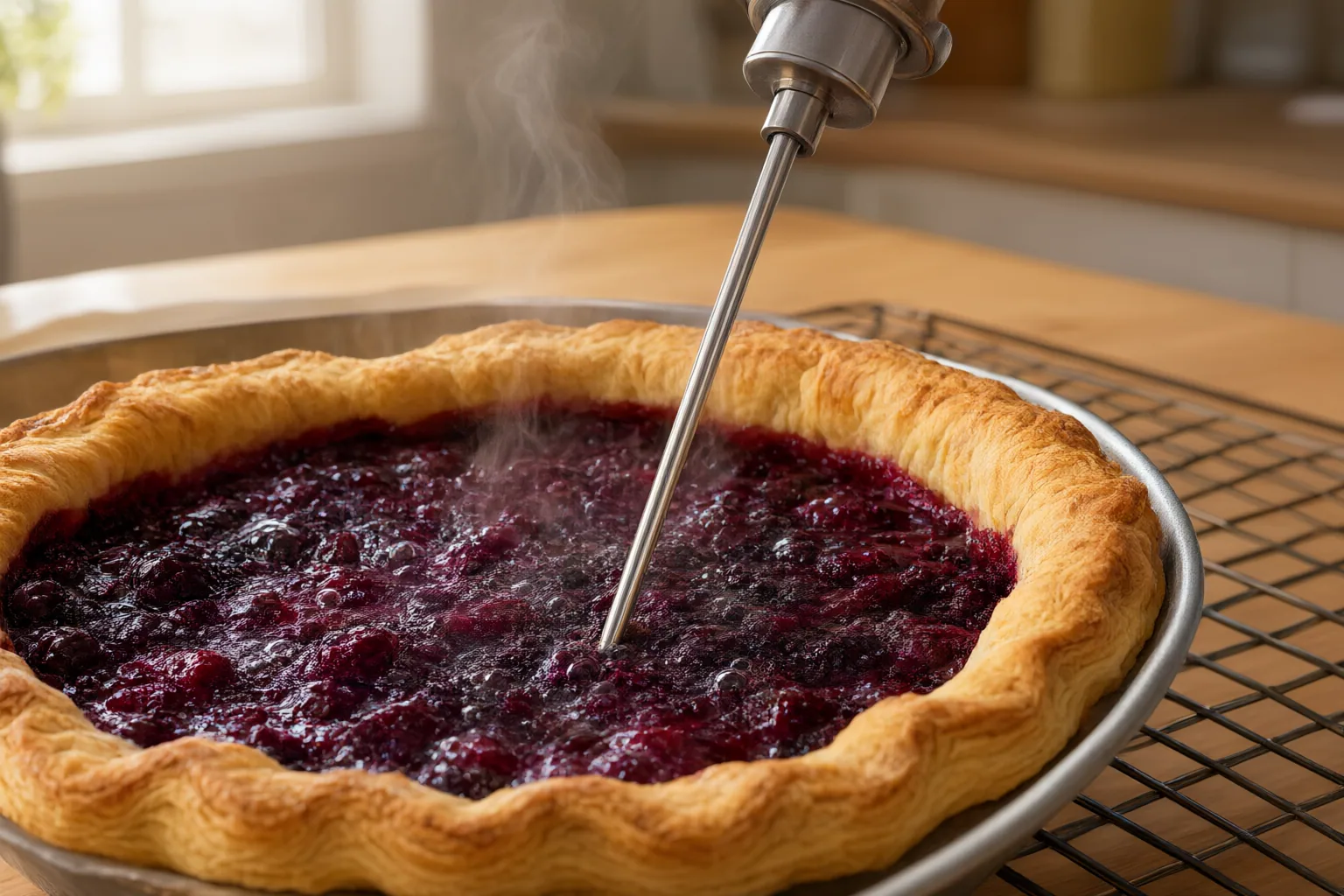
Choose equipment intended to reheat cold food. FoodSafePal and ServSafe Practice caution against using equipment designed primarily for hot holding, because it may raise the temperature too slowly. That distinction matters for a large or dense item whose exterior can warm well before its center.
In their leftover or hot-holding contexts, both sources say previously cooked, cooled, and stored food should reach 165°F (74°C) for 15 seconds within two hours. FoodSafePal specifies verification with a calibrated food thermometer, while ServSafe Practice calls for probing the center. This is relevant safety context, but it is not a pie-specific heating formula. Whether that standard applies to a particular pie depends on its ingredients, prior handling, and how it will be served.
Use the pie’s label to select the approved appliance, temperature, preparation, and timing. Do not improvise settings from general guidance when the label supplies specific directions. Whatever method the label permits, allow heat to reach the center and verify the result there before serving. If the center has not met the applicable label or safety direction, continue only as those directions allow and check it again.
Reduce Cold Spots During Microwave Reheating
Microwaves can produce hot and cold spots, so FoodSafePal recommends covering food to retain moisture, rotating or stirring it midway, and leaving it covered for two minutes after heating so the internal temperature can equalize. The food scientist quoted by Tasting Table also recommends stirring or rotating microwaved leftovers and allowing at least a two-minute standing period to distribute heat more evenly.
Apply these practices only when they are compatible with the pie’s label, container, and construction. Stirring, for example, may not be practical for an intact pie, while rotation or repositioning may be possible. Do not assume that a crisp-looking crust, visible steam, or a very hot edge means the filling’s center is ready.
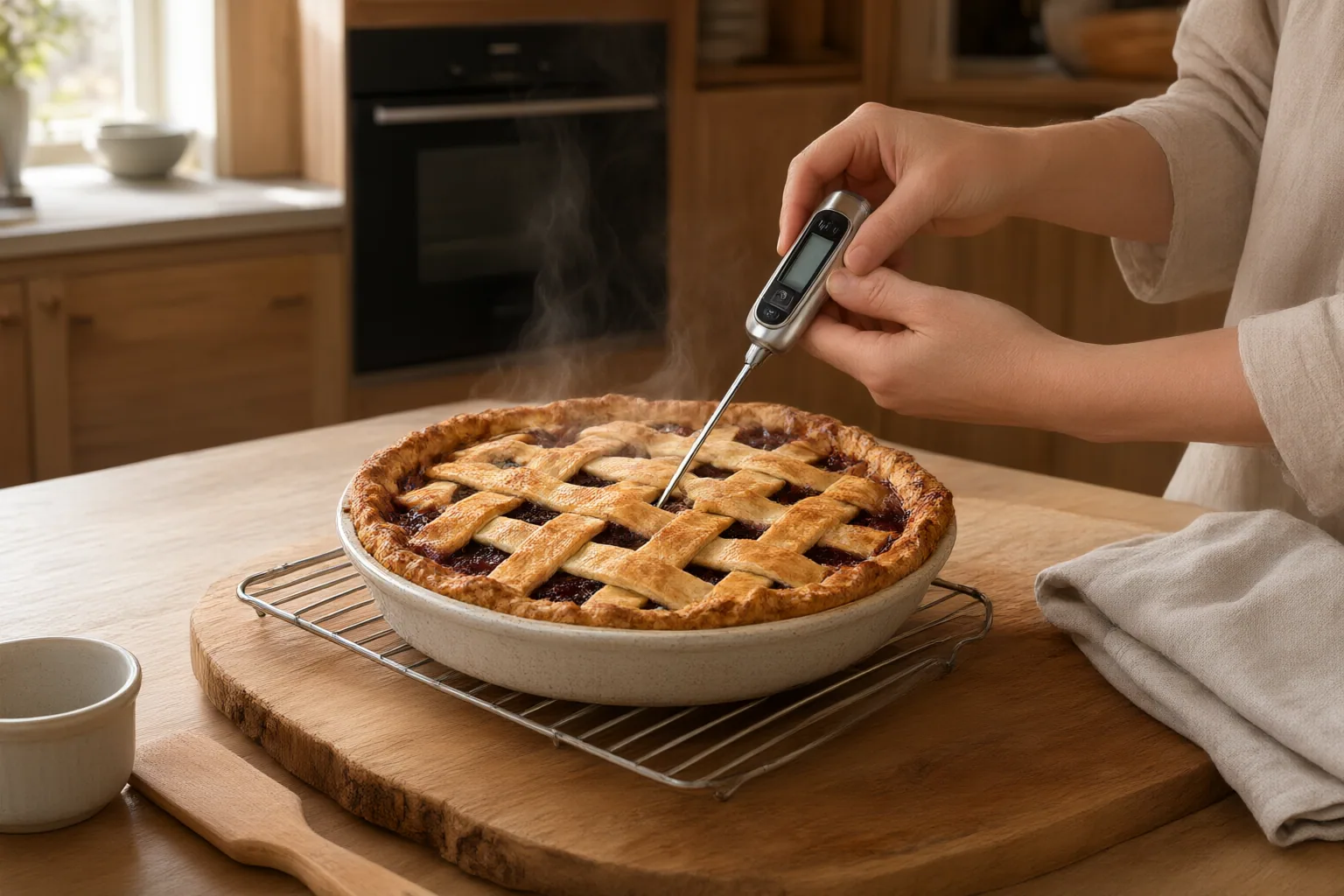
After the permitted standing period, measure the center with a food thermometer. If the label directs checks in a different location or specifies additional steps, follow it. The standing period helps heat redistribute, but it does not replace a temperature check or correct an unsuitable reheating method.
Conclusion
Safe reheating starts before the appliance is switched on. Consider whether the pie was cooled and stored safely, read its label, and use equipment capable of reheating cold food promptly. Follow the labeled method and then measure the center instead of treating a hot surface as proof that the whole pie is heated through.
Reheating is not a reliable way to rescue food that was previously held at unsafe temperatures. The cited sources warn that some bacterial toxins or spores may remain after heating. If the pie’s earlier handling or storage was unsafe, or its history is uncertain enough that safety cannot be established, do not rely on reheating to make it safe.
Before serving, place a suitable food thermometer in the center and confirm that the reading meets the product label or other applicable food-safety direction. If it does not, do not serve the pie as though the steaming exterior were sufficient evidence.
Disclosures and limitations
- This article was prepared with AI assistance from the supplied FoodSafePal, ServSafe Practice, and Tasting Table source material. Those sources provide general leftover or hot-holding guidance, not manufacturer instructions or government guidance for a particular pie.
- No products are recommended here and no affiliate relationship is represented. Always follow the exact product label when it is available.