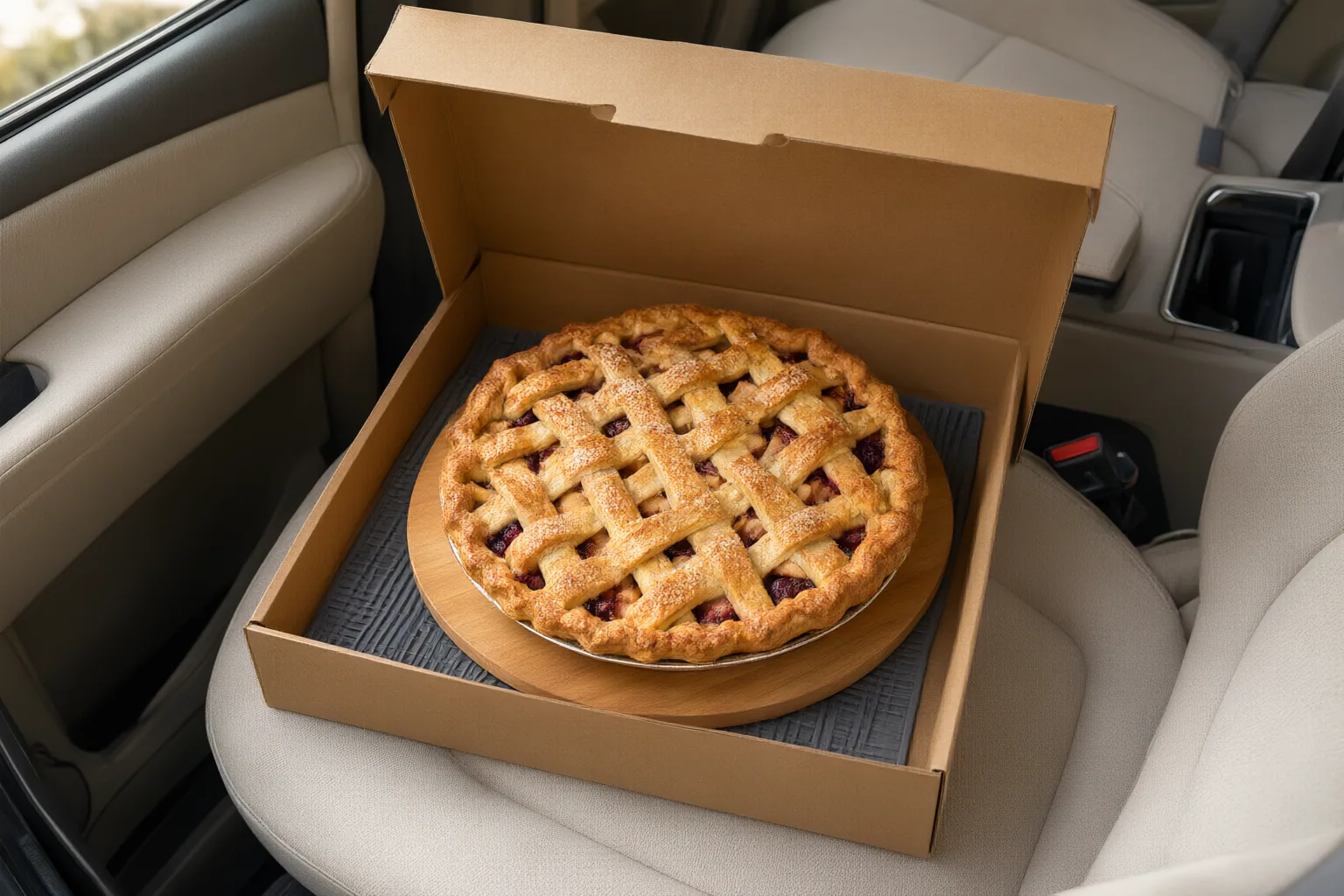
For a short car trip, cool the pie before packing it, support it on a rigid level base, place it in a sturdy box or carrier with a non-slip liner, and keep the package flat in the vehicle. Follow the recipe or product label for storage, temperature, preparation, and allergen requirements.
Let the pie cool before packing
Begin by letting the pie cool before wrapping it. The cited car-travel guidance starts with this step because packing a pie while it is still hot can create problems for the crust. Once the pie has cooled, Taste of Home recommends wrapping it completely in aluminum foil.
General transportation advice does not replace instructions for a particular pie. Before packing, check the recipe or product label for any storage or temperature requirements. Those directions are especially important when the filling or topping requires handling beyond the basic steps used to stabilize a pie during a short drive.
Prepare the pie before loading the car rather than trying to finish the package on an uneven seat or in the cargo area. A cooled, fully assembled package is easier to position carefully and leaves fewer opportunities for the pie to shift while it is being moved.
Build a rigid, non-slip packing setup
Support the pie from underneath on a flat, rigid surface. Taste of Home specifically recommends placing a foil-wrapped pie on a baking sheet and using another piece of foil to secure the pie and sheet together. Keep the assembly level as you transfer it into its outer container.
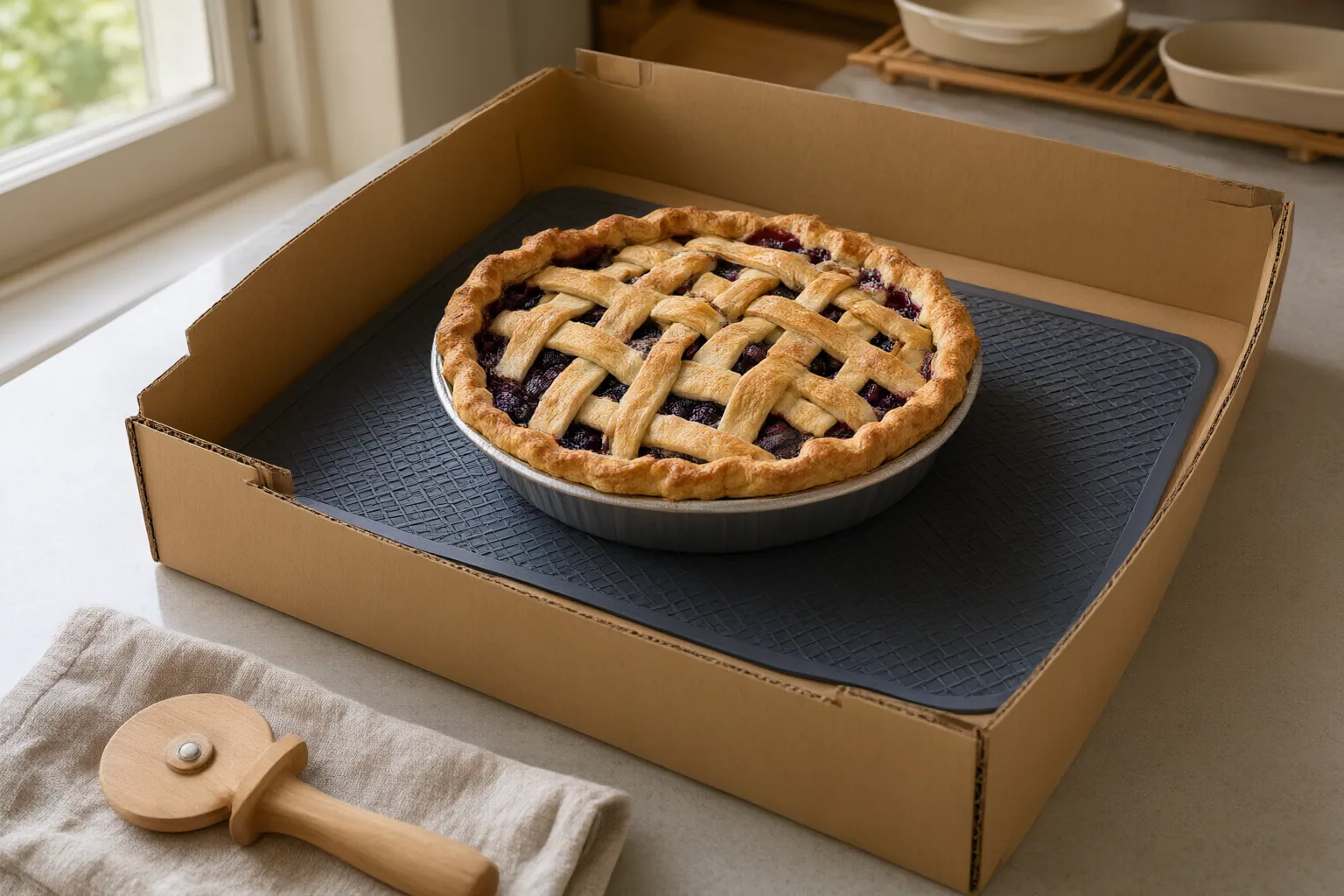
Next, place the supported pie in a sturdy pie box or carrier. Leave clearance around the edges so the crust does not rub against the container sides. This is particularly helpful for reducing damage caused by pressure or contact during handling.
Add a grippy drawer or shelf liner to the bottom of a flat box. Both Taste of Home and QuartzMountain recommend this kind of non-slip layer to reduce sliding during a drive. The goal is to control movement at each level: the pie should be supported by its base, the base should remain stable inside the box, and the closed box should stay level when lifted.
Before carrying the package to the vehicle, gently check that the pie assembly is not free to slide across the liner and that the crust has adequate clearance. Do not press packing material against a delicate crust merely to fill open space; the cited guidance emphasizes sturdy support from below and room around the pie’s edges.
Choose a flat place in the car and drive smoothly
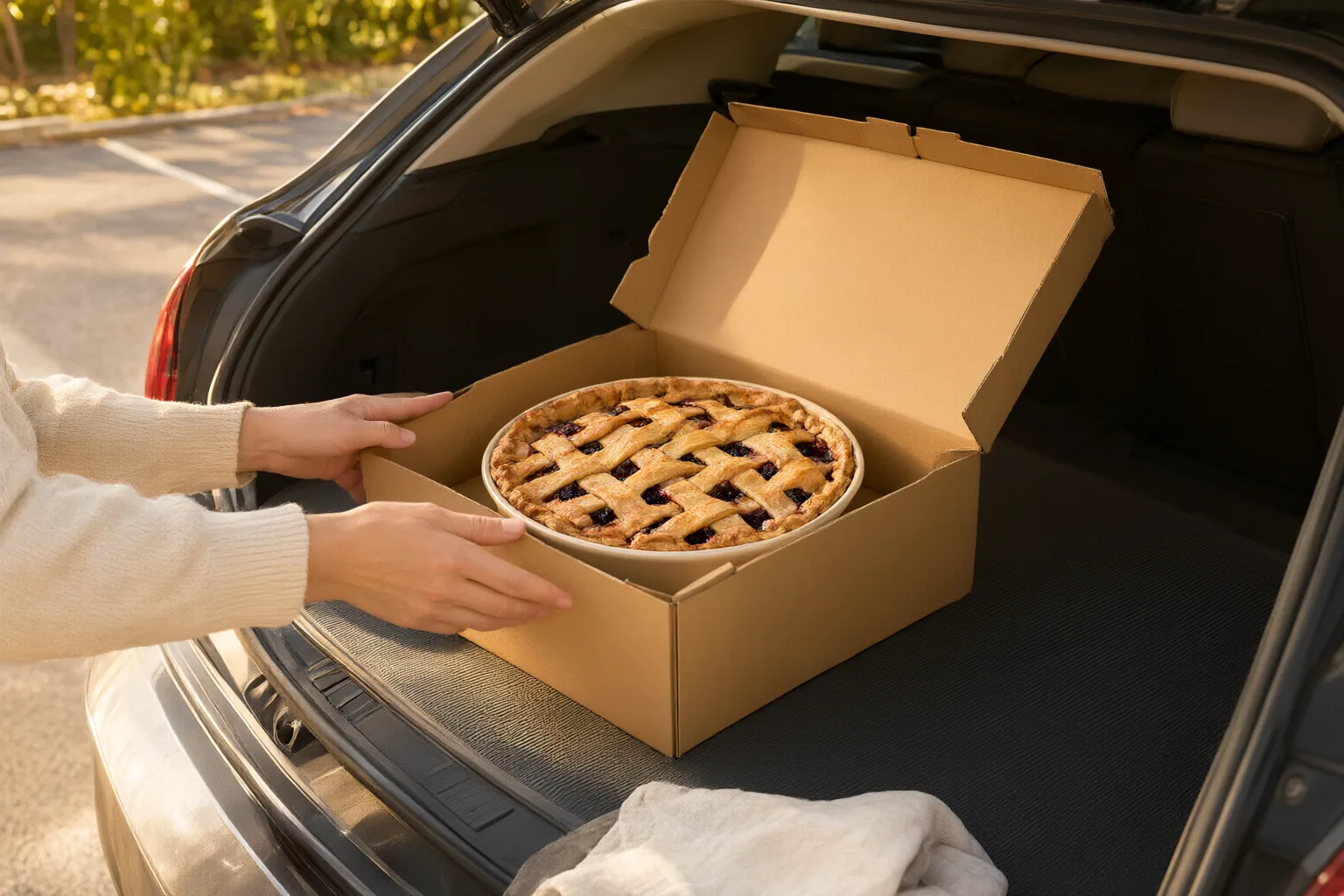
Set the packed pie on a flat, level part of the vehicle rather than on a surface where it can lean or tip. Taste of Home identifies the car floor as a flat placement area, while QuartzMountain also notes that a suitable cargo area may work when space permits. Whichever location you choose, confirm that the package sits level and is not able to move freely.
Handle the box from underneath and avoid sudden movements. Kitchenwisdom advises supporting a pie on a flat surface and limiting motions that could cause it to shift or tip. Apply the same care while loading, driving, turning, braking, and unloading: smoother movement gives the package less momentum to overcome its non-slip setup.
The appropriate handling can vary with the pie. Delicate crusts, heavy fillings, meringue, and whipped-cream toppings may have different needs. Use the recipe or product label—not general transport advice—to determine any specific temperature, storage, preparation, or allergen precautions. The box-and-liner setup addresses physical stability during a local trip; it does not establish food-storage requirements for every pie style.
Conclusion
Packing for a short local drive is different from preparing a pie for shipment. Paper Mart’s mail-shipping guidance uses a pie box inside a padded outer shipping carton. That more elaborate arrangement illustrates the additional protection associated with mailing and should not be treated as mandatory for every brief car journey.
For local transport, focus on the simpler sequence supported by the car-travel sources: cool the pie, give it firm support from underneath, use a sturdy box or carrier with adequate crust clearance, add a non-slip liner, and place the package on a flat vehicle surface. Before departure, check cooling, base stability, box clearance, non-slip support, and vehicle placement, then follow the recipe or label for any remaining storage, temperature, preparation, or allergen directions.
Disclosures and limitations
- This article was prepared with AI assistance from the supplied research package and its cited sources; no personal product testing or firsthand use is claimed.
- No specific commercial product is recommended here. Readers should consider any future product links or affiliate relationships separately and follow the exact recipe or product label for storage, temperature, preparation, and allergens.
Related reading
Sources
- How to Transport Your Pie Without Ruining It — Taste of Home
- Traveling With Pies: Packing Tips For Perfect Arrival — QuartzMountain
- How to Ship Pies: A Step-by-Step Guide to Mailing Pies | Can You Mail a Pie? — Paper Mart Blog – Boxes, Bags, Ribbon, Tulle and More
- The Ultimate Guide to Transporting Pies: Tips, Tricks, and Expert Advice – kitchenwisdom — kitchenwisdom