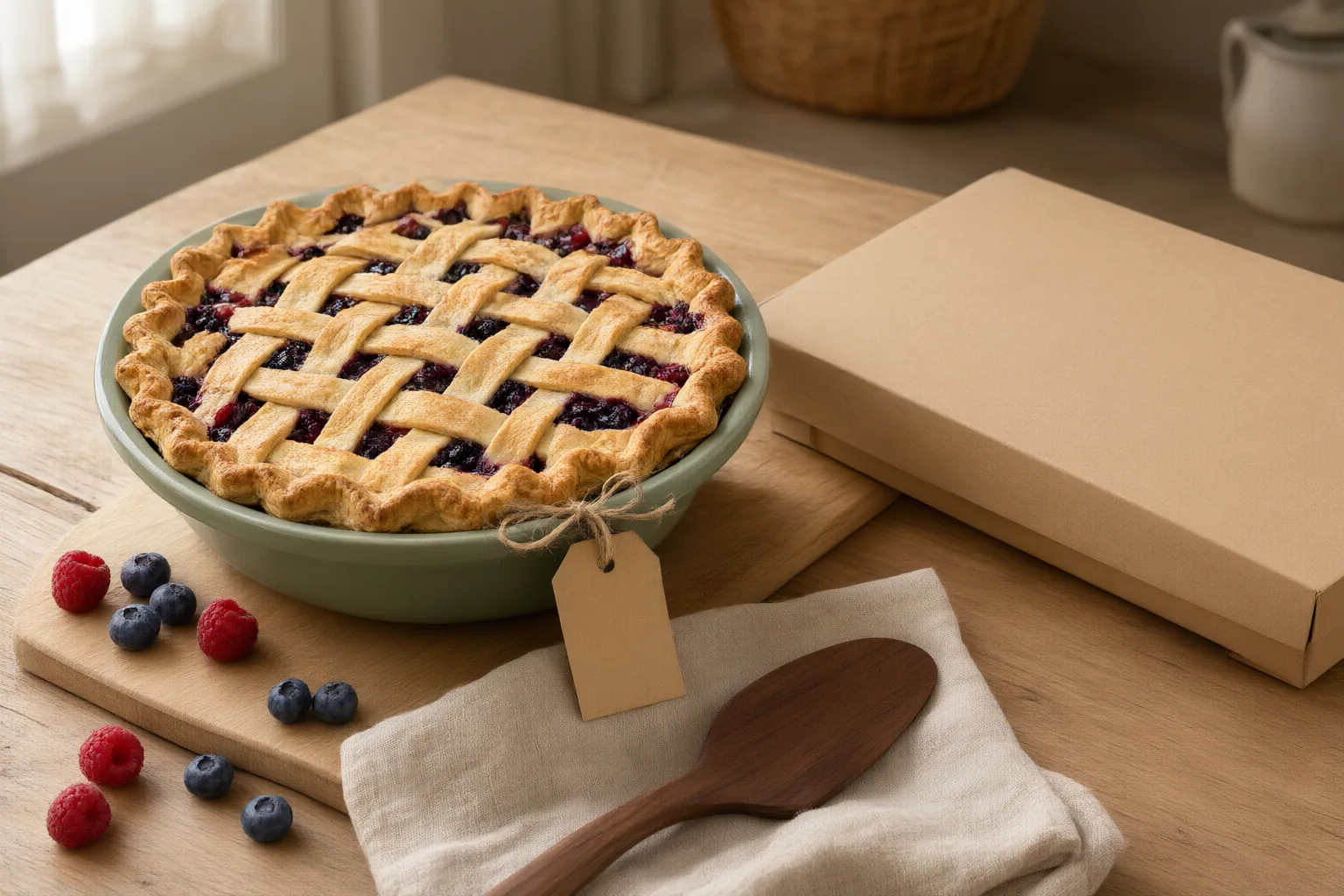
A useful pie-gift note names the filling, states whether the pie belongs on the counter or in the refrigerator, gives a use-by period, and includes only the freezing and reheating directions appropriate to that pie.
Start the care note with the pie type
Begin with the pie’s name and the ingredients that determine how it should be stored. Guidance differs for sugar-sweetened fruit pies, fresh-fruit or dairy-based pies, egg-based pies, and pies made with sugar substitutes. A generic instruction such as “keep refrigerated if needed” leaves the recipient to guess and may be inappropriate for the filling.
State the storage location and time limit plainly. If the recipe provides more specific handling directions, use those instead of general guidance. For a commercial pie, the University of Maine Cooperative Extension advises following the product label because some perishable commercial pies contain preservatives and may have different storage instructions.
A practical opening might read: “This is a sugar-sweetened apple pie. Store it at room temperature for no more than two days, then refrigerate it.” Include the date it was made or the resulting use-by date so the recipient does not have to calculate the storage window.
Give storage and freezing directions by filling
Use the category that matches the recipe:
- Sugar-sweetened fruit pie: UC Agriculture and Natural Resources says an apple, berry, or similar pie may remain at room temperature for up to two days. It can then be loosely wrapped and refrigerated for up to two more days. Alternatively, refrigerate it immediately for up to seven days.
- Fresh-fruit, custard, cream, or chiffon pie: Refrigerate promptly after cooking and cooling, keep refrigerated until serving, and store for no more than four days. UC Agriculture and Natural Resources says these pies do not freeze well.
- Pumpkin, pecan, or another egg-based pie: Refrigerate for up to four days. Pumpkin and pecan pies may be frozen for up to two months, although freezing can leave the crust soggy or cause the filling to separate. Thaw them in the refrigerator.
- Pie made with sugar substitutes: Refrigerate and consume within one to two days. For longer storage, place it in an airtight container or wrap it well and freeze it for up to two months.
Write only the directions that apply to the gifted pie. If freezing is suitable, specify how to wrap it, the supported freezer limit, and where to thaw it. If it does not freeze well, say so directly rather than offering a general freezing instruction.
Add gentle reheating instructions and two quick FAQs
Reheating directions should be optional and should identify the method, temperature, approximate time, and signs to watch for. LipTouchFoods offers general guidance—not instructions validated for every homemade recipe—of warming a whole pie in a 300–350°F oven. Its method places the pie on a parchment-lined baking sheet, covers it with foil to protect the crust, and warms it for 15–30 minutes, or until warm and crisp.
For one serving, LipTouchFoods suggests placing the slice on a microwave-safe plate, covering it with a paper towel, and heating it for 10–30 seconds. Warn the recipient to avoid excessive heating: it can make the crust soggy or burned and leave the filling excessively hot.
Because the appropriate method depends on the filling and ingredients, do not present either option as universal. Omit reheating directions when the recipe requires different handling, and include the recipe-specific directions instead.
Conclusion
Before gifting the pie, check that the note identifies the pie and its relevant ingredients, says “refrigerate” or gives a supported counter limit, supplies a clear use-by period, and explains whether freezing is suitable. Where applicable, add wrapping, freezer-limit, refrigerator-thawing, and gentle reheating directions, including any texture cautions.
Confirm the recipe’s particular requirements, calculate the dates from when the pie was made, and attach the completed care note before transporting or giving it to the recipient.
Disclosures and limitations
- This article was prepared with AI assistance from the supplied research package and uses attributed general guidance rather than advice validated for a particular homemade recipe.
- No products are recommended and no affiliate relationship is represented; recipe-specific directions and applicable product labels should take precedence.
Related reading
Sources
- The Art of Storing and Reheating Pie: A Comprehensive Guide – LipTouchFoods — LipTouchFoods
- Keeping Pies Safe – Cooperative Extension: Food & Health – University of Maine Cooperative Extension — Cooperative Extension: Food & Health
- Preserve it! Series: How to Keep Your Pies Food Safe | UC Master Food Preservers of Central Sierra — UC Agriculture and Natural Resources